| I understand the large hearts of heroes, |
| The courage of present times and all times; |
| How the skipper saw the crowded and rudderless wreck of the steamship, and death chasing it up and down the storm, |
| How he knuckled tight and gave not back one inch, and was faithful of days and faithful of nights, |
| And chalked in large letters on a board, Be of good cheer, We will not desert you; |
| How he saved the drifting company at last, |
| How the lank loose-gowned women looked when boated from the side of their prepared graves, |
| How the silent old-faced infants, and the lifted sick, and the sharp-lipped unshaved men; |
| All this I swallow and it tastes good . . . . I like it well, and it becomes mine, |
| I am the man . . . . I suffered . . . . I was there. |
And some context:
A little bit about steamship wrecks in the 19th Century: it was so common, that in 1856 (one year after Whitman's first publication of "Leaves of Grass") that James T. Lloyd put out a book on steamships called Steamboat Directory and Disasters on the Western Waters that was more disasters than directory, complete with illustrated examples.
A 19th century steamboat:

The ship is huge, industrial, and probably not affordable travel to all. The steamship symbolizes something large, formidable, and able-bodied. It is the aristocracy of sea travel.
OED definition of "skipper" given into the 19th century:
1. a. The captain or master of ship, esp. of a small trading, merchant, or fishing vessel; {dag}a shipman, seaman. In the 15th and 16th cent. chiefly in Sc. use.
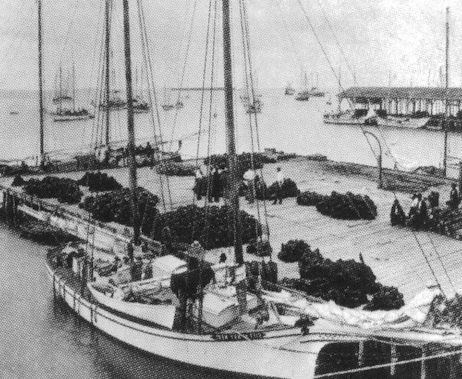
A 19th Century fishing boat:

The skipper's ship is certainly not of the same caliber as a steamship. It is small and relatively insignificant when compared to the steamship. The skipper's ship is the working class of sea travel.
And finally, the illustrated example of the 19th century shipwreck:

These were not uncommon in the 19th century, and the skipper saves an entire "company" of travelers on his small, inferior boat.
***************************************************************************
I think that it doesn't take a genius to realize what Whitman's talking about in these lines (even without the context so generously provided above). A big part of Whitman's project with "Leaves of Grass," I think, is the bringing together of everything. He wants to level the high class and the low class, the literate and the illiterate, the learned and the unlearned, the old and the young, the urban and the rural.
The skipper, captain of a small ship, the common man, the low class, the unlearned and unrefined, saves the huge steamship, luxury travel and giant compared to his small pragmatic vessel. The lines are a testimony to the "large [and heroic] hearts" of smaller men can come to the rescue of men, women, and children on the formidable but wrecked steamship. The skipper (the very word implying some kind of inferiority to the hunkering "steamship"), though smaller, lower, and less significant, pledges no to "desert" them and instead "saved" them, with "large letters" from his "large heart." These people that can afford gowns and steamship travel need listen to the words of this thought-to-be lesser man to survive disaster.
The voice of the common man matters, too; he is able; he is heroic.


very interesting! Some things I thought about too: technology - - how "modern" was the steamship in 1855? how high or low tech? Also - - Whitman loves the water - - and the poem is full of images of water, from bathing to waves to swimming - - etc. - - how does this image fit into these? finally, heroism - - Whitman wants to "heroize" the low, the common etc. . . what are the elements of this new "democratic hero"? And, don't forget, this scene is repeated toward the end of the poem, when Walt tells us:
ReplyDelete"Long have you timidly waded, holding a plank by the shore,
Now I will you to be a bold swimmer,
To jump off in the midst of the sea, and rise again and nod to me and shout, and
laughingly dash with your hair."
E.g. - - it's the same kind of drowning/saving image .. 'tho maybe reversed in your example. The captain's chalked note however reminds me of his own poem as a "chalked" message to us . .the swimmers who might be drowning . . .